
Brain Health · Healthy Aging · Artificial Intelligence · Neurology

What if your voice could reveal how quickly your brain is aging? Scientists are increasingly discovering that the way people speak may contain valuable information about brain health, cognitive function and age-related neurological changes.
Recent research supported by the National Institutes of Health (NIH) suggests that artificial intelligence (AI) can analyze subtle speech characteristics to identify patterns associated with accelerated biological aging, mild cognitive impairment and dementia.
A study highlighted by NIH on October 27, 2026, introduces an emerging approach called a speech-based aging clock. It could eventually help researchers monitor brain aging through simple voice recordings rather than relying entirely on expensive medical examinations.
🔬 What Did the New NIH Research Discover?
Researchers led by scientists associated with the Global Brain Health Institute investigated whether speech patterns could estimate biological aging and identify characteristics associated with dementia.
The study, published in Science Advances on September 30, 2026, analyzed speech recordings from 2,928 Spanish-speaking participants across five Latin American countries.
Approximately half of the participants had mild cognitive impairment, Alzheimer’s disease or frontotemporal dementia.
Researchers developed a machine-learning system that examined hundreds of speech characteristics, including:
- Voice pitch: Changes in the frequency and characteristics of someone’s voice.
- Speaking speed: How quickly someone produces words and sentences.
- Speech timing: Pauses, rhythm and the timing between words.
- Word choice: Vocabulary and language patterns.
- Emotional expression: Changes in emotional characteristics conveyed through speech.
The researchers combined these features to develop a speech-based biological aging estimate.
One important finding was that participants with cognitive impairment or dementia were more likely to have a higher speech-predicted biological age than their chronological age.
The gap was larger among participants with Alzheimer’s disease and even larger among those with frontotemporal dementia.
These findings suggest that speech may contain measurable information about the aging brain. National Institutes of Health (NIH)+1
🗣️ How Can Your Voice Reveal Brain Aging?
Speaking is a complicated neurological activity. The brain must retrieve memories, select appropriate words, organize sentences, control breathing and coordinate the muscles responsible for producing speech.
As neurological conditions develop, some of these processes may become less efficient.
This can produce subtle changes in everyday communication.
Slower Speaking and Longer Pauses
People experiencing cognitive difficulties may take longer to retrieve familiar words or organize their thoughts.
Researchers can measure the frequency and duration of pauses to identify changes in speech patterns.
Difficulty Finding the Right Words
Word-finding difficulties are among the recognized language-related symptoms associated with cognitive impairment.
Someone might frequently pause, replace specific words with general expressions or struggle to remember familiar names.
Changes in Voice Pitch and Expression
Speech is not simply about the words people use. Pitch, rhythm and emotional expression also contribute to communication.
Changes in these characteristics may provide additional information about neurological functioning.
Reduced Vocabulary and Sentence Complexity
AI systems can examine vocabulary diversity, sentence structure and the amount of meaningful information conveyed during a conversation.
These patterns may help researchers identify changes that are difficult to detect through ordinary observation.
Importantly, none of these individual changes proves that someone has dementia.
🤖 How Does AI Turn Speech Into a Digital Biomarker?
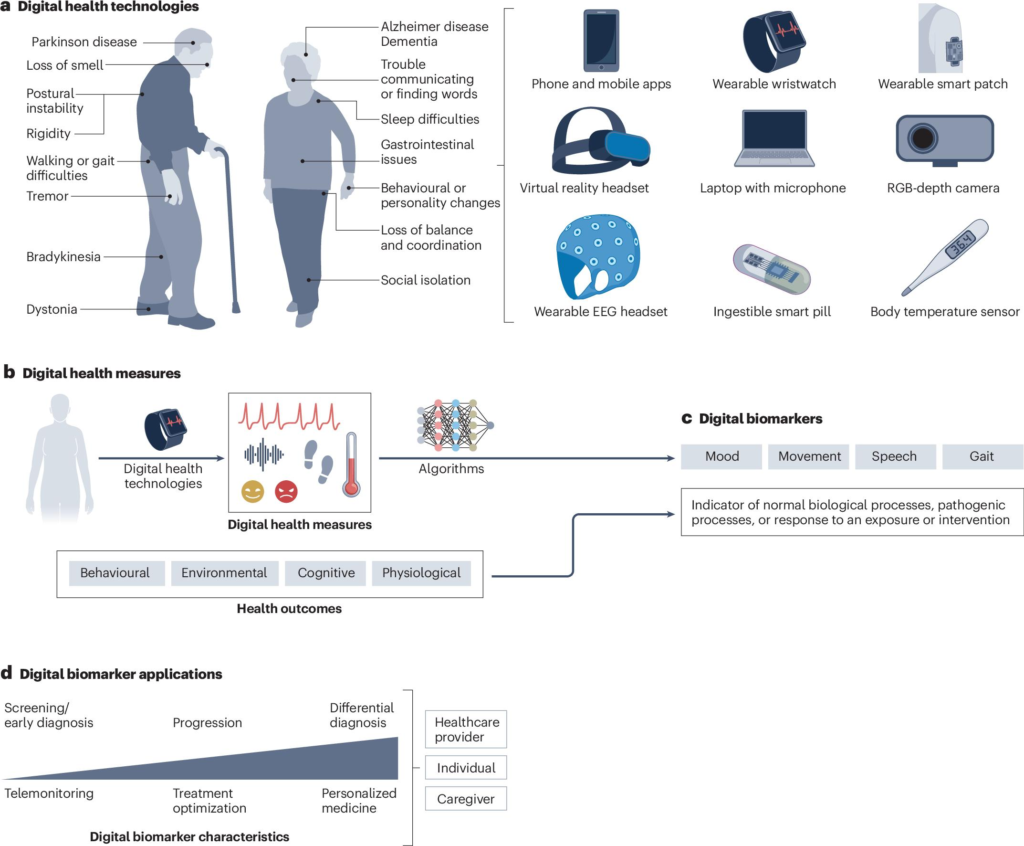
A digital biomarker is a measurable characteristic collected through digital technology that provides information about a person’s health.
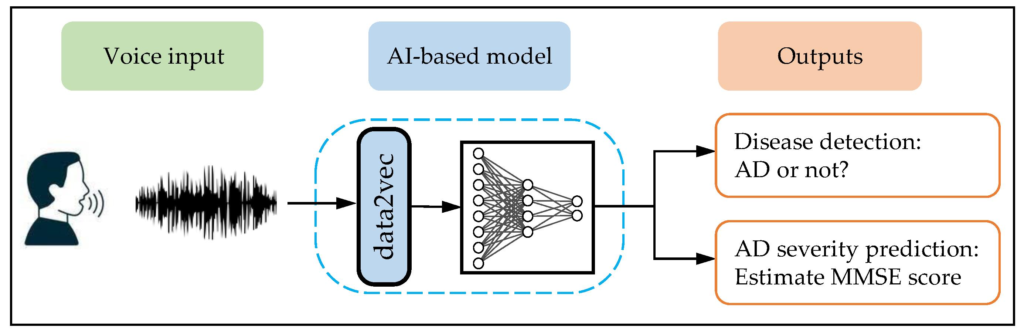
Voice-based digital biomarkers use microphones, speech recordings and AI algorithms to examine communication patterns.
The process generally involves four stages:
- Voice recording: A participant speaks naturally or completes a short speaking exercise.
- Speech processing: Software extracts acoustic and linguistic characteristics.
- AI analysis: Machine-learning models identify patterns associated with aging or cognitive impairment.
- Risk assessment: Researchers examine whether the speech characteristics are associated with cognitive health outcomes.
In the future, this technology could potentially be incorporated into smartphones, wearable devices and telehealth platforms.
It might allow healthcare professionals to monitor changes in speech over time and identify individuals who could benefit from further cognitive assessment.
🧬 What Is a Speech-Based Aging Clock?
Traditional biological aging clocks estimate biological age using different measurements, including DNA-related markers, blood-based indicators and brain imaging.
A speech-based aging clock takes a different approach.
It uses patterns in spoken language and vocal characteristics to estimate biological aging.
Researchers calculate a measurement called the speech age gap.
| Measurement | Meaning |
|---|---|
| Chronological age | Actual age in years |
| Speech-predicted age | Age estimated using speech characteristics |
| Speech age gap | Difference between predicted and chronological age |
For example, imagine someone is 65 years old but their speech-based model estimates an age of 73.
The difference is eight years.
This does not mean that the person has dementia or that their brain is literally eight years older. It indicates a statistical difference that researchers can investigate alongside other health measurements.
The NIH-highlighted research found that larger speech age gaps were associated with poorer cognitive test performance. Among participants with Alzheimer’s disease, larger gaps were also associated with higher blood levels of the Alzheimer’s-related protein p-tau217. National Institutes of Health (NIH)
❤️ Can Voice Technology Help Detect Dementia Earlier?
Early detection of dementia is important because it can help individuals and families access appropriate medical evaluation, support and treatment planning.
Speech analysis could eventually contribute to this process.
For example, a digital system might monitor changes in an individual’s speech over several months rather than relying on a single recording.
Potential applications include:
- Early identification of speech changes associated with cognitive impairment.
- Monitoring language and communication abilities.
- Supporting dementia screening in primary healthcare.
- Helping researchers follow neurological changes over time.
- Making preliminary cognitive monitoring more accessible in areas with limited healthcare resources.
An additional NIH-funded study published in January 2025 found that AI analysis of speech transcripts predicted progression from mild cognitive impairment to Alzheimer’s disease within six years with 78.2% accuracy in a study of 166 participants. National Institute on Aging
This provides further evidence that language patterns could become useful tools in dementia research.
🇮🇳 Could Voice-Based Dementia Screening Help India?
India has a large and growing older population, making accessible approaches to brain health increasingly important.
Voice-based screening could potentially offer advantages in communities where specialist neurological services and advanced diagnostic facilities are limited.
Smartphones and inexpensive microphones could make speech collection relatively straightforward.
However, India presents an important scientific challenge: linguistic diversity.
People speak different languages, including Hindi, Odia, Bengali, Tamil, Telugu and Malayalam. Even within one language, regional accents and speaking styles vary.
An AI model trained primarily on Spanish or English speech cannot automatically be assumed to work accurately for Indian populations.
Researchers would need large, diverse datasets representing Indian languages, ages, educational backgrounds and regional speech patterns.
A 2024 study investigating vocal biomarkers included research participants from Kerala, India, demonstrating the relevance of this research area to Indian populations. PMC
⚠️ What Are the Limitations of This Technology?
Despite promising findings, voice-based dementia detection remains an emerging research approach.
Several challenges must be addressed before it becomes a routine clinical tool.
Normal aging versus dementia: Speaking more slowly or forgetting words occasionally can happen during normal aging. These changes do not automatically indicate neurological disease.
Language differences: Accents, dialects, education and cultural communication styles can influence speech analysis.
Other health conditions: Hearing difficulties, respiratory illnesses, depression, medications and voice disorders may affect speech characteristics.
Privacy concerns: Voice recordings contain personal information and potentially identifiable biometric characteristics. Secure data storage and informed consent are essential.
Clinical validation: Researchers need larger, more diverse and long-term studies to establish how reliably these models predict future cognitive decline.
The NIH report specifically emphasizes the need for longitudinal research before speech-based clocks can be used to predict aging-related health problems confidently. National Institutes of Health (NIH)
🔮 What Could the Future of Voice-Based Health Monitoring Look Like?
Imagine recording a short conversation through your smartphone every few months.
An AI system could examine changes in speaking speed, vocabulary, pauses, pitch and emotional expression.
If significant changes appeared over time, the system might recommend a professional cognitive assessment.
This approach could eventually become part of preventive healthcare, alongside blood tests, physical activity monitoring and other digital health measurements.
However, voice analysis should complement—not replace—medical examinations, cognitive assessments and established diagnostic methods.
📝 Conclusion
Your voice may reveal more about your brain health than previously understood. Emerging research suggests that subtle changes in pitch, speaking speed, pauses, vocabulary and emotional expression can provide measurable clues about biological aging and cognitive impairment.
The October 2026 NIH-highlighted research on speech-based aging clocks represents an interesting development in digital health and dementia research.
Although this technology is not yet a standalone diagnostic tool, it could eventually make brain health monitoring more accessible, affordable and convenient.
The future of dementia research may involve not only examining the brain through scans and blood tests but also understanding the information hidden in everyday conversations.