
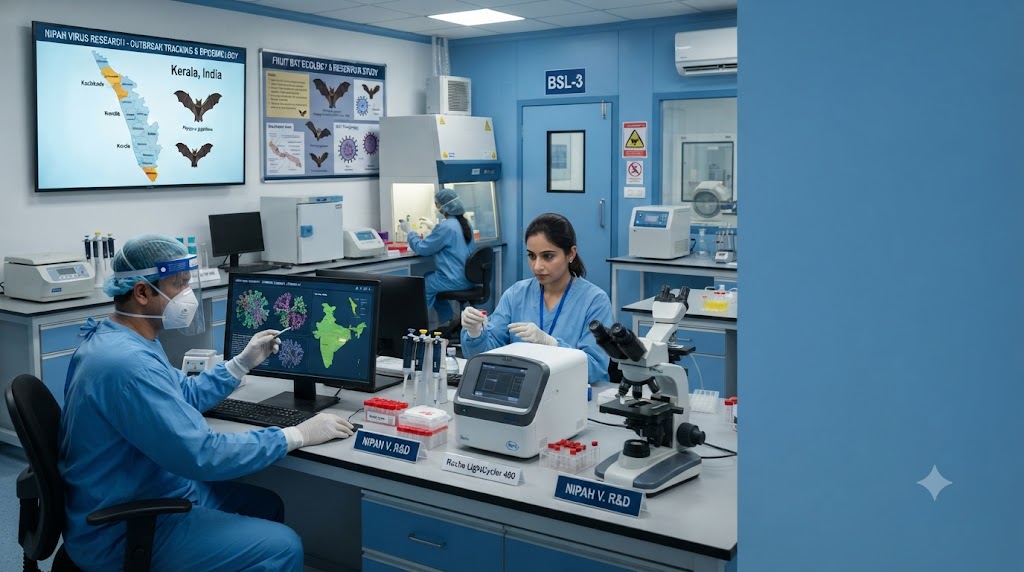
Introduction: Why Nipah Research Matters in India
Nipah virus (NiV) is a rare but serious zoonotic infection that has become an important focus of infectious-disease research in India. The virus can cause severe neurological disease and encephalitis, while transmission can occur from infected animals to humans and, in some circumstances, between people through close contact.
India’s experience with Nipah has been concentrated particularly in Kerala, although previous outbreaks have also occurred in West Bengal. Recent investigations in 2025 and 2026 have provided researchers and public-health authorities with valuable lessons about rapid diagnosis, contact tracing, infection prevention, genomic and ecological surveillance, and the importance of a One Health approach.
In June 2026, the World Health Organization reported a laboratory-confirmed Nipah case in Kozhikode, Kerala. Authorities identified 104 contacts and initiated active monitoring, while animal and environmental investigations were conducted to investigate possible sources of infection. No secondary cases had been reported at the time of the WHO assessment.
Earlier, in January 2026, two healthcare workers in West Bengal were confirmed to have Nipah infection. More than 190 contacts were tested, with no additional positive cases identified. A mobile BSL-3 laboratory from the National Institute of Virology (NIV), Pune, supported rapid testing during the investigation.
These investigations demonstrate how India’s Nipah research system has evolved from outbreak response toward a broader strategy involving early detection, field diagnostics, ecological surveillance, laboratory preparedness and integrated human-animal-environment investigations.
🦠 Understanding Nipah Virus
Nipah virus belongs to the henipavirus group and is considered a high-consequence zoonotic pathogen.
Fruit bats of the Pteropus genus are recognized as natural reservoirs. Human infection can occur through exposure to infected animals or contaminated food, while close contact with an infected person can also result in transmission.
The disease can initially resemble several other infections. Fever, headache and other nonspecific symptoms can occur before more serious neurological manifestations develop.
This creates a major diagnostic challenge.
A patient with an early nonspecific illness may not immediately appear to have Nipah virus infection. By the time neurological disease becomes apparent, healthcare workers may already have been exposed.
Consequently, early clinical suspicion, rapid laboratory confirmation and immediate infection-control measures are central to outbreak management.
WHO notes that there are currently no licensed vaccines or specific antiviral treatments for Nipah virus infection, making early supportive care and public-health containment particularly important.
📍 Kerala Has Become an Important Natural Laboratory for Nipah Research
Kerala has experienced repeated Nipah events since the major outbreak recognized in 2018.
WHO reported that Kerala experienced Nipah outbreaks in 2018, 2019, 2021, 2023, 2024, 2025 and 2026.
Repeated outbreaks have provided researchers with an unusual opportunity to study how the virus behaves in a densely populated setting with extensive healthcare connectivity.
The experience has also allowed public-health authorities to refine their response systems.
Instead of starting from scratch whenever a suspected case appears, Kerala has developed protocols involving rapid laboratory testing, contact tracing, isolation, healthcare-worker protection and community surveillance.
This accumulated experience has become one of India’s most valuable assets in dealing with Nipah.
🔬 Lesson 1: Rapid Diagnosis Can Change an Outbreak Investigation
One of the clearest lessons from India’s Nipah research is the importance of shortening the time between suspicion and laboratory confirmation.
The ICMR-National Institute of Virology has developed and evaluated rapid diagnostic technologies for Nipah.
ICMR reports that NIV developed a Nipah rapid test capable of generating results in approximately two hours.
The institute’s 2024–25 annual report also highlighted the development of RT-LAMP assays for Nipah with reported 100% sensitivity and specificity in the stated validation context.
These technologies are important because conventional laboratory workflows may require samples to be transported to specialized facilities.
During an outbreak, every hour can matter for decisions involving isolation, contact tracing and healthcare-worker protection.
Rapid diagnostics therefore represent more than a laboratory innovation. They can become an outbreak-management tool.
🧪 Mobile BSL-3 Laboratories Bring Testing Closer
Another important development is the use of mobile high-containment laboratory capacity.
During the January 2026 West Bengal investigation, a mobile BSL-3 laboratory was deployed by NIV, Pune, to support testing of contacts. WHO reported that more than 190 contacts were identified and tested, with all reported negative.
This approach can reduce dependence on transporting potentially high-risk clinical samples over long distances.
It also allows specialized testing capacity to move closer to an outbreak location.
India’s experience suggests that mobile laboratory infrastructure may be particularly useful for emerging infections in geographically dispersed areas.
The broader lesson is that laboratory preparedness needs to be considered part of outbreak preparedness.
🧑⚕️ Lesson 2: Healthcare Workers Need Special Protection
Healthcare workers have repeatedly played a central role in Nipah investigations.
The January 2026 West Bengal event involved two healthcare workers from the same private hospital. Both developed severe illness, and the investigation subsequently involved extensive contact tracing.
Healthcare settings can become important transmission environments because clinicians, nurses and other staff may have prolonged close contact with severely ill patients.
WHO therefore emphasizes infection-prevention and control measures, including appropriate precautions during aerosol-generating procedures.
This has influenced India’s research priorities.
Outbreak investigations increasingly examine not only the patient but also:
Where the patient received treatment.
Which healthcare workers were exposed.
What procedures were performed.
What protective equipment was used.
How quickly isolation occurred.
How contacts were identified.
Such information can reveal opportunities to improve hospital infection control.
🧭 Lesson 3: Contact Tracing Remains One of the Most Powerful Tools
Modern laboratory technology receives considerable attention, but contact tracing remains fundamental.
During the June 2026 Kerala event, authorities identified 104 contacts, including healthcare workers and other close contacts, and placed them under monitoring.
In the January 2026 West Bengal event, more than 190 contacts were identified and tested.
Contact tracing allows authorities to identify people who may have been exposed before they develop symptoms.
This can create an early-warning system.
If a contact develops compatible symptoms, testing can occur rapidly rather than waiting for the person to enter the healthcare system independently.
The effectiveness of contact tracing depends on speed, accurate exposure histories, laboratory capacity and cooperation between health authorities and communities.
🏠 Lesson 4: Door-to-Door Surveillance Can Add Another Layer
The 2026 Kerala investigation demonstrated another useful approach.
WHO reported that door-to-door surveys were conducted across 320 households involving 1,047 residents in a municipality division associated with the investigation. No Nipah-compatible symptoms were identified among those surveyed.
Community surveillance can help detect symptoms that might otherwise go unreported.
It also provides an opportunity for health officials to communicate with residents, answer questions and explain precautions.
This is particularly important during outbreaks because fear and misinformation can spread alongside the virus.
Effective outbreak communication is therefore part of disease control.
🦇 Lesson 5: Human Outbreaks Cannot Be Studied in Isolation
Nipah is a zoonotic disease, so understanding human cases requires studying animal reservoirs and environmental conditions.
This is where the One Health concept becomes especially important.
One Health recognizes that human health, animal health and environmental conditions are interconnected.
During the June 2026 Kerala investigation, animal-health teams collected bat specimens and samples from bat-roosting sites within a defined area around the suspected epicentre. Samples were sent to the National Institute of High Security Animal Diseases in Bhopal for testing.
The objective is not simply to find the virus in bats.
Researchers also want to understand:
Where reservoir populations occur.
Whether the virus is circulating in those populations.
Whether seasonal patterns exist.
How humans interact with wildlife.
What environmental factors could increase spillover opportunities.
This information may eventually help authorities anticipate risk rather than responding only after a human case appears.
🦇 Research Is Expanding Beyond Outbreak Areas
Nipah surveillance is increasingly extending beyond locations where human outbreaks have already occurred.
NIV’s current publication record includes a 2026 study examining Nipah virus prevalence in Pteropus medius bats from non-outbreak regions of India. NIV has also published research on Nipah surveillance in bats from eastern and northeastern India and in Kerala.
This research is important because the absence of recent human cases in an area does not necessarily mean the virus cannot occur there.
Studying wildlife populations can provide information about where the virus may be circulating.
It can also help researchers understand whether ecological conditions could support future spillover.
🌳 Ecology and Seasonality Are Important Research Questions
Repeated outbreaks have encouraged researchers to investigate seasonal and ecological patterns.
WHO identifies April to September as a locally recognized higher-alert period for Nipah in Kerala, while also noting the role of fruit-bat populations and ecological conditions in supporting repeated spillover events.
Seasonality does not mean that transmission can occur only during a specific period.
Instead, it suggests that environmental and ecological factors may influence the probability of spillover.
Researchers therefore examine variables such as rainfall, fruit availability, bat behaviour, habitat changes, human-wildlife interactions and agricultural practices.
This is another reason Nipah surveillance cannot be limited to hospitals.
🧬 Lesson 6: Genomic and Laboratory Research Can Track Viral Evolution
Modern outbreak investigation increasingly uses molecular biology and genome sequencing.
Genomic data can help researchers determine whether cases are genetically related and can provide information about the virus circulating in different locations.
This can be especially useful when several cases appear close together.
If viral genomes are highly similar, investigators can examine whether cases could be linked epidemiologically. If they differ substantially, separate spillover events may need to be considered.
Genomic surveillance therefore adds another layer to traditional epidemiological investigation.
It does not replace contact tracing or field investigation, but it can strengthen them.
🧪 The 2025 Kerala Outbreak Provided Another Important Lesson
The 2025 Kerala events demonstrated the importance of investigating apparently separate cases.
WHO reported four confirmed cases between May and July 2025, involving Malappuram and Palakkad districts. The sources of infection remained under investigation, and the cases did not appear to be epidemiologically linked.
That observation is scientifically important.
If cases are not linked through known human-to-human transmission chains, researchers must investigate the possibility of repeated independent spillover from an animal reservoir.
This reinforces the value of environmental and wildlife surveillance.
It also illustrates why every confirmed Nipah case can generate research questions extending beyond the individual patient.
🧠 Neurological Symptoms Make Early Recognition Difficult
Nipah can cause encephalitis and other neurological manifestations.
However, early symptoms may be nonspecific.
WHO noted in its January 2026 assessment that difficulty with early diagnosis remains an important challenge because early symptoms are not specific to Nipah.
This creates a difficult clinical problem.
Doctors must recognize when an apparently routine febrile illness could represent a high-consequence infection while avoiding unnecessary testing of every patient with fever.
This is where outbreak history, epidemiological information, clinical judgement and rapid diagnostic capacity work together.
🧑🔬 Lesson 7: Research and Outbreak Response Must Work Together
India’s Nipah experience demonstrates that laboratory research is most useful when it is integrated with public-health operations.
A diagnostic test developed in a laboratory becomes much more valuable when clinicians know when to use it.
A genomic platform becomes more useful when samples are collected systematically.
Wildlife surveillance becomes more meaningful when findings can inform human-health preparedness.
Mobile laboratories become effective when they can be deployed rapidly to suspected outbreak locations.
This integration between research and response is one of the strongest lessons emerging from India’s Nipah experience.
📱 Digital Epidemiology and Data Management
Another area of research involves improving how outbreak information is collected and analyzed.
Contact lists, laboratory results, symptom monitoring, geographic exposure histories and healthcare-worker contacts can generate large quantities of information.
Digital systems can help health authorities organize these data and identify potential transmission links.
During an outbreak, however, speed must be balanced with privacy and data quality.
Incorrect contact information or delayed data entry can weaken an investigation.
Sensitive medical and personal information must also be protected.
The future of infectious-disease surveillance will therefore require both technological capability and strong governance.
💉 Why Vaccine and Antiviral Research Remain Important
Despite progress in diagnosis and outbreak management, an important limitation remains: there is currently no licensed Nipah vaccine or specific antiviral treatment.
WHO continues to identify vaccine and therapeutic development as major areas of research.
Several experimental vaccine and antiviral candidates have been investigated internationally, but research-stage products should not be confused with licensed treatments.
For India, this means prevention currently depends heavily on:
Early recognition.
Rapid laboratory confirmation.
Isolation and infection prevention.
Contact tracing.
Active surveillance.
Supportive clinical care.
Animal and environmental investigations.
These measures can reduce transmission even in the absence of a licensed vaccine.
🏥 Supportive Care Remains Central
Because there is no licensed specific treatment for Nipah, clinical management depends heavily on supportive care.
Severe patients may require intensive-care support, respiratory assistance and management of neurological complications.
This makes hospital preparedness particularly important.
A hospital responding to a suspected Nipah patient needs not only diagnostic capacity but also appropriate isolation facilities, personal protective equipment, trained staff and infection-control procedures.
The quality of supportive care can influence outcomes, although Nipah remains a serious disease with substantial mortality reported across outbreaks. WHO estimates case-fatality rates across outbreaks at approximately 40–75%, while noting variation between outbreaks and healthcare settings.
🔬 India’s Rapid Diagnostic Research Is a Major Asset
India’s investment in rapid diagnostic research has produced practical tools for outbreak response.
The ICMR-NIV annual report for 2024–25 described RT-LAMP diagnostic development for Nipah and highlighted mobile BSL-3 deployment during outbreaks. The report states that mobile laboratory deployment reduced diagnostic turnaround time to approximately four hours in the described outbreak-response context.
Faster testing can improve several decisions simultaneously.
It can help clinicians determine whether specialized isolation is required.
It can help epidemiologists begin targeted contact tracing.
It can reduce uncertainty for healthcare workers.
It can help authorities decide whether enhanced community surveillance is necessary.
This demonstrates why diagnostic research is an important part of epidemic preparedness.
🌍 Could Other Indian States Face Nipah Risk?
Although recent outbreaks have been concentrated in Kerala and West Bengal, researchers continue to investigate the wider geographic distribution of the virus.
WHO noted in 2025 that studies had detected Nipah antibodies in fruit bats in several other Indian states, suggesting that the possibility of emergence outside historically affected areas should not be ignored.
This does not mean that human outbreaks are occurring throughout India.
Instead, it supports continued surveillance of potential ecological reservoirs and maintenance of diagnostic preparedness.
A strong national surveillance system can help identify an unusual cluster before it becomes a larger outbreak.
🧭 The One Health Model Could Become the Future of Nipah Research
Nipah provides a particularly clear example of why infectious-disease research needs to move beyond hospitals.
A future surveillance system could combine:
Human surveillance — monitoring unexplained encephalitis and compatible clinical syndromes.
Laboratory surveillance — rapid molecular testing and confirmatory diagnostics.
Wildlife surveillance — testing bats and other relevant animals.
Environmental surveillance — examining ecological factors associated with spillover.
Genomic surveillance — comparing viral genomes.
Digital epidemiology — mapping contacts and transmission chains.
Community surveillance — identifying symptoms outside healthcare facilities.
This integrated system would allow researchers to study Nipah at multiple levels simultaneously.
📈 What Recent Investigations Have Taught Researchers
The recent Indian experience provides several broad lessons.
First, speed matters. Rapid testing can reduce uncertainty and accelerate public-health decisions.
Second, healthcare workers require strong protection, because hospitals can become important sites of transmission.
Third, contact tracing remains essential, even when modern laboratory technology is available.
Fourth, wildlife investigations are necessary because Nipah is a zoonotic disease.
Fifth, mobile laboratory capacity can bring advanced diagnostics closer to outbreak locations.
Sixth, repeated outbreaks can strengthen preparedness, because each investigation generates information that can improve future response.
Finally, research must connect laboratory science with field epidemiology and healthcare delivery.
🔮 What the Next Phase of Nipah Research May Focus On
India’s next generation of Nipah research is likely to emphasize several interconnected areas.
More sensitive and faster point-of-care diagnostics could help shorten the time from symptoms to confirmation.
Expanded wildlife surveillance could improve understanding of viral circulation among bat populations.
Genomic sequencing could help investigators characterize viral diversity and transmission relationships.
Artificial intelligence and digital epidemiology could potentially assist with identifying unusual clusters and organizing large contact datasets.
Clinical research may continue to investigate antiviral candidates and vaccines.
Meanwhile, One Health programmes could increasingly combine environmental, veterinary and human-health information.
The goal is not simply to react faster after a Nipah case appears.
The larger objective is to identify risk earlier and strengthen preparedness before transmission expands.
📝 Conclusion
Recent Nipah investigations in India demonstrate how outbreak research has evolved into a multidisciplinary effort involving virology, epidemiology, clinical medicine, wildlife science, laboratory technology and public-health surveillance.
The 2026 West Bengal investigation showed the value of rapid contact identification and mobile laboratory testing, with more than 190 contacts tested without additional confirmed cases reported in the investigation.
The 2026 Kerala investigation demonstrated the continuing importance of contact tracing, community surveillance and One Health investigations involving bats and the environment.
Meanwhile, ICMR-NIV’s work on rapid diagnostics, mobile BSL-3 laboratories and surveillance of Pteropus bats demonstrates how research infrastructure is increasingly being integrated into outbreak preparedness.
Perhaps the most important lesson is that Nipah cannot be addressed through one technology alone. Rapid diagnosis, trained healthcare workers, infection prevention, contact tracing, wildlife surveillance, genomic research and community engagement must operate as parts of the same system.
India’s repeated experience with Nipah has created a valuable body of knowledge for preparing for future outbreaks—not only of Nipah virus, but potentially of other emerging zoonotic diseases as well. 🦠🔬🌏🇮🇳