


Category: Biotechnology · Regenerative Medicine · Drug Discovery · Personalized Medicine
Introduction
Imagine testing a potential medicine on a miniature version of a patient’s own tissue before deciding whether that treatment might work. This is one of the exciting possibilities emerging from organoid research.
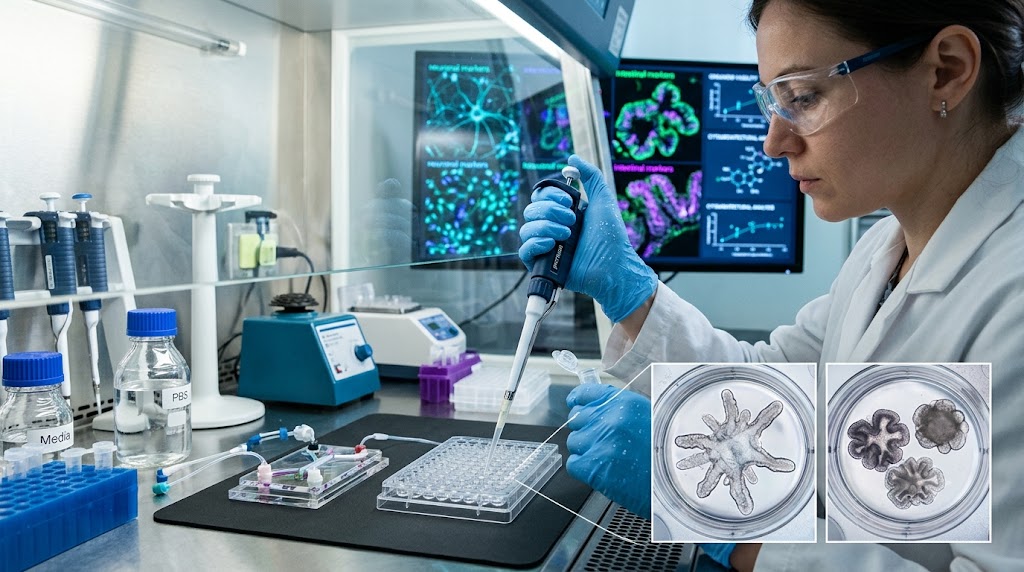
Organoids are three-dimensional, laboratory-grown structures made from stem cells or other suitable cells. Under carefully controlled conditions, these cells organize themselves into structures that reproduce selected features of real organs, such as the intestine, liver, brain, or lungs.
Although organoids are not complete miniature human organs, they can reproduce certain aspects of human tissue architecture, cellular diversity, and biological function. These characteristics make them valuable tools for investigating diseases and evaluating experimental treatments.
Traditional drug development relies on several approaches, including laboratory cell cultures, animal studies, and clinical trials. Each provides important information, but none perfectly predicts how a medicine will behave in every human patient. Organoids may help close some of these gaps by offering a more biologically representative model of human tissue.
Could this technology change how scientists discover medicines, assess toxicity, and develop personalized therapies? Let’s explore the science, emerging applications, limitations, and future possibilities.
What Are Organoids, and How Are They Created?

Organoids are three-dimensional biological models grown from stem cells, tissue-derived cells, or other cells capable of forming organized tissue structures. Unlike conventional cell cultures, which often grow as flat layers, organoids develop in three dimensions and can reproduce selected features of the original tissue.
A 2026 review in Nature Reviews Drug Discovery describes human organoids as promising platforms for studying disease mechanisms, evaluating drug effectiveness and toxicity, and investigating differences in individual treatment responses.
How scientists grow miniature tissues
The process begins with selecting an appropriate cell source. Researchers may use adult stem cells collected from tissue samples or induced pluripotent stem cells (iPSCs), which are created by reprogramming mature cells into a stem-cell-like state.
The selected cells are placed in a carefully controlled environment containing nutrients, growth factors, and, in many systems, a supportive three-dimensional matrix. These conditions encourage the cells to multiply, specialize, and organize into structures resembling aspects of a particular organ.
For example, intestinal stem cells can form miniature intestinal structures containing different types of intestinal cells. Researchers can then study how those cells respond to infection, inflammation, or experimental medicines.
The process generally involves several stages:

Step 1: Select the cells
Researchers obtain suitable stem cells or tissue cells from a donor, a patient sample, or an established cell line.

Step 2: Create suitable growth conditions
Cells receive nutrients, growth signals, and a supportive environment that encourages tissue organization.

Step 3: Allow organoids to develop
Cells multiply and arrange themselves into three-dimensional structures with selected organ-like characteristics.

Step 4: Test and analyze
Scientists expose organoids to experimental compounds and measure changes in cell survival, tissue structure, molecular activity, or other relevant outcomes.
The resulting organoids can be examined using microscopy, genetic analysis, molecular assays, and automated imaging. These methods help researchers determine whether a treatment affects the intended biological target and whether it causes signs of tissue damage.
However, organoid development is not identical for every cell type. Different tissues require different culture conditions, and some models reproduce mature organ functions more successfully than others.
Organoids versus traditional cell cultures
Traditional two-dimensional cell cultures remain useful because they are relatively straightforward, inexpensive, and suitable for many laboratory experiments. However, they do not always reproduce the spatial organization and cell-to-cell interactions found in real tissues.
Organoids can provide a more complex environment in which cells interact in three dimensions. This may improve the study of diseases that depend on tissue architecture or interactions between different cell populations.
Nevertheless, a more complex model is not automatically a more accurate one. The usefulness of an organoid depends on the biological question being investigated and whether the model has been validated for that purpose.
Why Organoids Could Improve Drug Testing

Developing a new medicine is a complicated process. A drug may work well in a laboratory experiment but prove ineffective or unsafe when tested in a whole organism. Some treatments fail because the disease behaves differently in humans than in experimental models. Others cause unexpected side effects or work only for particular patient groups.
Organoids may help researchers investigate these problems earlier in the development process.
More representative models of human biology
One of the main advantages of human organoids is their ability to reproduce selected characteristics of human tissue.
For example, a liver organoid may help researchers examine how liver cells respond to a candidate medicine. An intestinal organoid may help investigate how intestinal tissue reacts to inflammation or infection. A lung organoid may help scientists study the effects of respiratory viruses or experimental treatments.
These models can reveal biological responses that simpler cell cultures might not capture. Their value is particularly important when researchers need to understand interactions among different cell types or study disease-related changes in tissue organization.
Organoids still cannot fully reproduce the complexity of an entire human body. However, they can provide a useful intermediate level of biological detail between simple cell experiments and whole-organism studies.
Identifying promising drugs earlier
Drug developers often screen many candidate compounds before identifying a small number worth advancing.
Organoids can be used to test multiple compounds at different concentrations and compare their biological effects. Researchers can investigate which compounds appear effective, which produce signs of toxicity, and which warrant additional investigation.
This approach may help prioritize promising candidates before more expensive studies begin.
Importantly, an organoid result is evidence about how a model responds under specific experimental conditions. It is not proof that the drug will work in patients. Promising findings still require further testing and validation.
Studying drug toxicity
A treatment can damage healthy tissue even when it successfully targets a disease. Understanding these risks is essential for developing safer medicines.
Liver, kidney, heart, and intestinal models may help researchers investigate certain forms of drug-related tissue injury. Depending on the organoid system, scientists can measure changes in cell viability, tissue structure, metabolic activity, or other biological markers.
These findings may reveal warning signs before a candidate medicine progresses to later development stages.
However, some toxic effects depend on blood circulation, immune reactions, interactions among organs, or drug metabolism throughout the body. Conventional organoids may not reproduce these processes completely. Researchers therefore need to combine organoid results with other appropriate evidence.
Major Applications of Organoids in Medical Research

Cancer research and treatment selection
Tumor-derived organoids can preserve important features of a patient’s cancer, including aspects of its cellular diversity. Researchers can expose these models to different medicines and compare their responses.
This may help investigate treatment resistance, identify candidate therapies, and understand why tumors with similar diagnoses can respond differently. Clinical use remains dependent on validation and the particular cancer type.

Neurological disorders
Brain organoids can reproduce selected features of early human brain development and some neurological disease processes. Scientists use them to study cellular changes associated with conditions such as certain developmental disorders and neurodegenerative diseases.
They may also help investigate experimental treatments. Yet these models do not possess the full architecture, connectivity, or functioning of a human brain.

Gut health and infectious disease
Intestinal organoids can help scientists investigate how pathogens interact with intestinal cells, how inflammation develops, and how potential treatments affect intestinal tissue.
They are useful for studying aspects of gastrointestinal disease and host–pathogen interactions that may be difficult to reproduce in conventional cell cultures.

Liver disease and drug safety
Liver models can support research into metabolic disorders, liver injury, and how certain medicines affect liver cells.
Better models of human liver biology could improve early safety screening, although complete prediction of whole-body drug metabolism remains challenging.

Respiratory diseases
Lung organoids can help researchers examine airway development, infection, tissue damage, and potential therapies for respiratory conditions.
More advanced systems may incorporate additional cell types and supporting structures to improve the representation of lung biology.
These applications illustrate why organoids have become an important research platform. Each model must still be assessed according to the disease, tissue, and treatment being investigated.
Personalized Medicine: Testing Treatments Using a Patient’s Cells

One of the most promising possibilities is personalized medicine: selecting treatments based on the characteristics of an individual patient rather than relying exclusively on average responses observed across large groups.
How patient-derived organoids work
In a potential cancer-treatment application, a clinician may collect a tumor sample during a biopsy or surgery. Suitable cells from that sample can then be grown into patient-derived tumor organoids.
Researchers can expose these organoids to selected treatments and measure their responses. The results may reveal differences in drug sensitivity between tumors that otherwise appear similar.
For instance, two patients with the same broad cancer diagnosis may have tumors with different molecular characteristics. One tumor may respond to a particular drug in laboratory testing, while another shows little response.
Organoid experiments could provide additional evidence to help researchers understand these differences and investigate alternative treatment strategies.
Could this change cancer care?
The long-term goal is to determine whether testing a patient’s tumor outside the body can help clinicians choose treatments more effectively.
But several questions must be answered before organoid-guided treatment becomes routine. Can the model be created quickly enough? Does its response reliably predict the patient’s clinical outcome? Does using the result improve survival, quality of life, or another meaningful outcome compared with standard care?
These questions require well-designed clinical studies, reproducible testing methods, and validation across diverse patient populations.
A 2026 review of organoid applications in personalized medicine identifies standardization, testing time, cost, and clinical validation as important barriers to wider adoption. Organoid results should therefore not be treated as a substitute for established medical advice or independently used to select or discontinue a patient’s treatment.
Recent Scientific Progress: Organoids With Blood Vessels

A major challenge in organoid research is the difficulty of reproducing the blood supply found in real organs.
Blood vessels deliver oxygen and nutrients while removing waste. Many conventional organoids lack mature, functional vascular networks, limiting their size, development, and ability to reproduce certain physiological processes.
In an August 5, 2025 research report, the US National Institutes of Health described work on miniature lung and intestinal tissues capable of generating specialized blood vessels. The research offers a potential route toward more representative tissue models and may help reduce reliance on some animal experiments.
Why vascularization matters
Without an adequate blood supply, cells in larger tissue structures may receive insufficient oxygen and nutrients. This can cause central regions to become damaged, making it difficult to maintain healthy, complex tissue over time.
Functional vascular networks could help researchers study how substances move through tissue and how cells respond to changes in oxygen supply, inflammation, or other conditions.
They could also support more advanced models for investigating certain diseases and drug effects.
However, creating blood vessels is only part of the challenge. Researchers must also reproduce appropriate immune-cell interactions, tissue support structures, and other features relevant to the disease or drug being studied.
The goal is not simply to grow larger organoids, but to create models that reproduce the biological features needed to answer specific research questions.
Organoids-on-a-Chip: Bringing Laboratory Models Closer to Real Organs
joint-research-centre.ec.europa.eu
Another promising development is the integration of organoids with microfluidic devices, often described as organoids-on-a-chip or related organ-on-a-chip systems.
These technologies combine biological tissue models with engineered devices that control the movement of fluids, nutrients, and experimental compounds. Depending on the design, they can reproduce selected features of circulation, mechanical movement, or interactions between different tissues.
How the technology works
A microfluidic chip contains tiny channels through which liquids can flow. Researchers can use these channels to supply nutrients, introduce candidate drugs, and monitor biological responses under controlled conditions.
Some platforms contain one tissue model, while more complex systems connect multiple tissue compartments. Such arrangements may help investigate how a substance affects different tissues or how one organ’s biological activity influences another.
For example, a connected liver–intestine system could help researchers explore aspects of drug absorption and metabolism. More advanced combinations may be designed to investigate how compounds affect several organs at once.
These systems could be particularly useful when the effects of a medicine depend on more than one tissue.
Why this matters for drug discovery
An isolated organoid may provide detailed information about a specific tissue, but it cannot independently reproduce every process that occurs throughout the human body.
Combining organoids with microfluidics may offer greater experimental control and a more realistic environment for studying selected physiological processes.
A 2025 review of organoids-on-a-chip describes their potential in drug discovery, disease modelling, and personalized medicine while highlighting continuing challenges involving biological maturity, reproducibility, and technical complexity.
Despite these advances, organoids-on-a-chip remain specialized research systems rather than universal replacements for existing drug-testing methods.
Can Organoids Reduce Animal Testing?
Animal studies have contributed substantially to medical research, but biological differences between species can make it difficult to predict every human response. Ethical concerns have also encouraged scientists to develop additional ways to investigate disease and treatment safety.
Organoids offer one potential alternative because researchers can study human-derived tissue models directly in the laboratory.
In April 2025, the National Institutes of Health announced an initiative to prioritize human-based research technologies, including approaches that may reduce animal use. The announcement highlighted the growing importance of advanced laboratory models in biomedical research.
What organoids may replace
Depending on the research question, organoids could help replace or reduce selected experiments that currently rely on animal-derived tissues or simpler laboratory models.
They may also help researchers screen experimental compounds before deciding which candidates deserve further investigation.
This could contribute to more efficient research while supporting efforts to reduce unnecessary animal use.
Why animal studies may still be necessary
A living organism contains interacting organ systems, circulating blood, immune responses, hormones, and many other processes that are difficult to reproduce completely in a laboratory.
Organoids cannot independently determine every aspect of a drug’s absorption, distribution, metabolism, elimination, or systemic toxicity.
For this reason, organoid research should be viewed as part of a broader scientific toolkit. Whether an alternative model can replace a particular animal study depends on the question being asked, the quality of the evidence, and the relevant scientific and regulatory requirements.
The long-term objective is better evidence with fewer unnecessary experiments—not replacing one imperfect model with another without adequate validation.
The Role of Artificial Intelligence in Organoid Research

Artificial intelligence (AI) could help researchers extract more information from organoid experiments. A single experiment may generate thousands of images, measurements, and molecular data points. Manually analyzing all of this information can be time-consuming and difficult to standardize.
AI-based image analysis and machine-learning methods may help researchers identify patterns that would otherwise be challenging to detect.
Automated imaging and cell analysis
Computer vision systems can be trained to measure organoid size, shape, growth, cell viability, and changes in tissue structure.
Researchers can use these measurements to compare experimental groups and identify possible responses to treatment.
Automation may also improve consistency by applying the same analytical rules across large numbers of samples, although the accuracy of the results depends on the quality of the data and the validation of the algorithms.
Predicting drug responses
Machine-learning models could combine organoid measurements with genetic information, molecular profiles, and previous experimental results to identify patterns associated with drug sensitivity or resistance.
For example, a model might help prioritize compounds for further testing based on characteristics shared by organoids that responded favorably in earlier experiments.
Such predictions must be tested on independent datasets. A model that performs well on the data used to train it may fail when applied to new patients, different laboratories, or unfamiliar biological conditions.
Toward more reproducible experiments
AI could also support quality control by detecting unusual organoid shapes, inconsistent growth, or other indicators that a culture may not be suitable for a particular experiment.
In the future, automated systems may combine imaging, robotics, and analytical software to produce and evaluate large numbers of organoids under standardized conditions.
These capabilities could make drug screening more efficient, but AI cannot compensate for a biological model that fails to represent the disease or tissue being studied. Reliable conclusions require both suitable experimental models and trustworthy computational analysis.
Challenges and Limitations of Organoid Technology

Despite their promise, organoids have important limitations. Understanding these challenges is essential for assessing their potential without overstating what the technology can currently achieve.
Incomplete representation of human organs
Organoids reproduce selected features of tissues rather than the complete structure and function of an entire organ.
Many models lack mature blood vessels, nerves, immune-cell networks, or other supporting structures. These omissions can influence how diseases develop and how medicines behave.
For example, a drug that appears effective against isolated tumor cells may behave differently in a patient’s body because of interactions with immune cells, blood vessels, surrounding tissue, or other organs.
Differences between organoid batches
Even when researchers use similar cell sources and culture conditions, organoids can vary in size, cell composition, maturity, and biological activity.
Such variation can affect experimental results. If two groups of organoids differ substantially before treatment, it may be difficult to determine whether an observed difference comes from the drug or from the underlying variation in the models.
Standardized culture methods, quality-control procedures, and validated measurement techniques are therefore essential.
Cost and technical complexity
Producing organoids requires specialized materials, controlled culture conditions, trained personnel, and suitable analytical equipment.
Some models also require substantial time to develop. Patient-derived organoids introduce additional challenges because tissue collection, culture establishment, and drug testing must be coordinated with the patient’s clinical circumstances.
These factors can make the technology expensive and limit its availability, particularly in laboratories with fewer resources.
Difficulties predicting whole-body responses
A medicine’s effects may depend on interactions among several organs. A compound could appear safe in one tissue model but cause harm elsewhere or produce metabolites that affect another organ.
Organoids do not automatically reproduce these interactions.
Researchers can address some of these limitations by connecting multiple tissue models, adding immune or vascular components, and integrating results with other experimental approaches. However, these improvements do not eliminate every uncertainty.
Ethical and regulatory questions
Organoid research raises questions about consent for donated tissues, privacy, ownership of biological samples, and the appropriate use of patient-derived material.
Brain organoids also raise scientific and ethical questions as researchers investigate increasingly complex neural development and function. These concerns require careful assessment without assuming that current organoids possess the same capabilities as a human brain.
For clinical use, researchers must also establish whether organoid-based tests are analytically reliable, clinically meaningful, and useful for improving patient outcomes.
A promising laboratory result alone does not establish that a test is ready for routine medical care.
The Future of Organoids in Medicine
The future of organoid research will depend on making these models more reliable, more representative of human biology, and easier to use at scale.
Several areas are particularly important.
Improved tissue complexity: Researchers are developing approaches to incorporate blood vessels, immune cells, supporting tissues, and other components needed to study more complex biological processes.
Standardized production: More consistent protocols and quality-control systems could make it easier to compare results across laboratories and determine whether findings can be reproduced.
High-throughput screening: Automation may enable researchers to evaluate many compounds across large numbers of organoids, improving the efficiency of early-stage drug discovery.
Patient-specific models: Organoids derived from individual patients may eventually provide additional evidence to guide treatment research, particularly in cancer and certain rare or complex diseases.
Integration with AI and microfluidics: Combining biological models with automated analysis and controlled fluid systems could help researchers investigate drug responses more systematically.
These developments are complementary. Better imaging cannot compensate for poor-quality tissue models, and more complex organoids are not necessarily useful unless they answer a clearly defined scientific question.
The most important measure of progress will be whether organoid-based methods consistently produce reliable findings and improve decisions in drug development or patient care.
What This Research Means for Patients and the Public
Organoid technology may eventually contribute to medicines that are developed more efficiently and selected more carefully for individual patients. It could also help scientists understand why certain treatments fail and identify promising alternatives earlier.
For patients, the most important potential benefit is better treatment evidence. If organoid-based tests are shown to predict clinical responses reliably, they could provide doctors with additional information when considering treatment options.
However, this possibility should not be confused with a current guarantee. Organoid testing is not a universal diagnostic or treatment-selection method, and availability varies by application. Patients should not delay established treatment or change prescribed medicines based on experimental organoid results.
For the public, continued progress in this field highlights the importance of supporting responsible biomedical research, transparent reporting, and rigorous clinical validation.
Conclusion: Could Mini-Organs Transform Drug Testing?
Organoids represent an important advance in biotechnology and regenerative medicine. By allowing researchers to grow three-dimensional tissue models, this technology offers new ways to investigate diseases, screen experimental drugs, study toxicity, and explore personalized treatment approaches.
Advances in vascularized organoids, organoids-on-a-chip, automation, and AI may help researchers address some of the limitations of earlier models. These technologies could make laboratory experiments more representative of human biology and help identify promising treatments before they reach clinical trials.
Nevertheless, organoids are not complete human organs. Their biological complexity, reproducibility, cost, and ability to predict clinical outcomes remain important challenges.
The most realistic future is one in which organoids complement other research methods, including conventional laboratory studies, computational models, and appropriately selected animal and human studies. As evidence improves, some organoid-based applications may become valuable tools in drug development and personalized medicine.
The central question is no longer simply whether scientists can grow miniature tissues in the laboratory. It is whether those tissues can provide dependable evidence that leads to safer medicines and better patient outcomes.
That is the scientific challenge—and the opportunity—that makes organoid research so exciting. 🧬
Frequently Asked Questions (FAQs)
What are organoids?
Organoids are three-dimensional, laboratory-grown structures made from stem cells or other suitable cells. They reproduce selected structural and functional features of real tissues.
Can organoids replace animal testing?
They may replace or reduce some experiments, depending on the research question. They cannot yet reproduce every whole-body process, so other methods may still be needed.
Can organoids predict which cancer drug will work for a patient?
Patient-derived tumor organoids can help researchers investigate drug sensitivity. Their ability to predict clinical outcomes varies, and routine treatment decisions require adequate validation.
Are organoids the same as artificial organs?
No. Organoids are tissue models that reproduce selected features of organs. They are not complete, fully functioning artificial organs suitable for replacing a patient’s organ.
How does AI help organoid research?
AI can analyze microscopy images, identify patterns in experimental data, support quality control, and help researchers prioritize candidate drugs for further testing.
When will organoid testing become routine?
There is no single timeline. Adoption will depend on the specific application, reliable testing procedures, regulatory requirements, and evidence that the results improve clinical decisions.