
For decades, strength training was often associated primarily with building bigger muscles, improving athletic performance, or changing body shape. Today, scientists increasingly view resistance exercise as something much more important: a potential cornerstone of healthy aging.
As people live longer, the goal is no longer simply to add years to life. It is to preserve the ability to walk, climb stairs, carry groceries, get up from a chair, maintain balance, and remain independent. And muscle strength plays a central role in all of these abilities.
Recent research is adding to the evidence. A large 2026 study published in the British Journal of Sports Medicine examined long-term resistance-training patterns and their relationship with mortality, while a 2026 systematic review in Scientific Reports analyzed 72 randomized trials involving more than 6,200 older adults with sarcopenia. Together with earlier meta-analyses, the research paints an increasingly compelling picture: maintaining muscle strength may be one of the most practical strategies for supporting healthier aging. (PubMed)
But there is an important distinction. Research showing that people who perform resistance training tend to live longer does not automatically prove that lifting weights directly causes a longer lifespan. Lifestyle, health status, diet, physical activity, smoking, socioeconomic factors, and many other variables can influence the results.
Still, the overall evidence is strong enough to make strength training worthy of serious attention.
🧬 Why Muscle Matters More as We Age
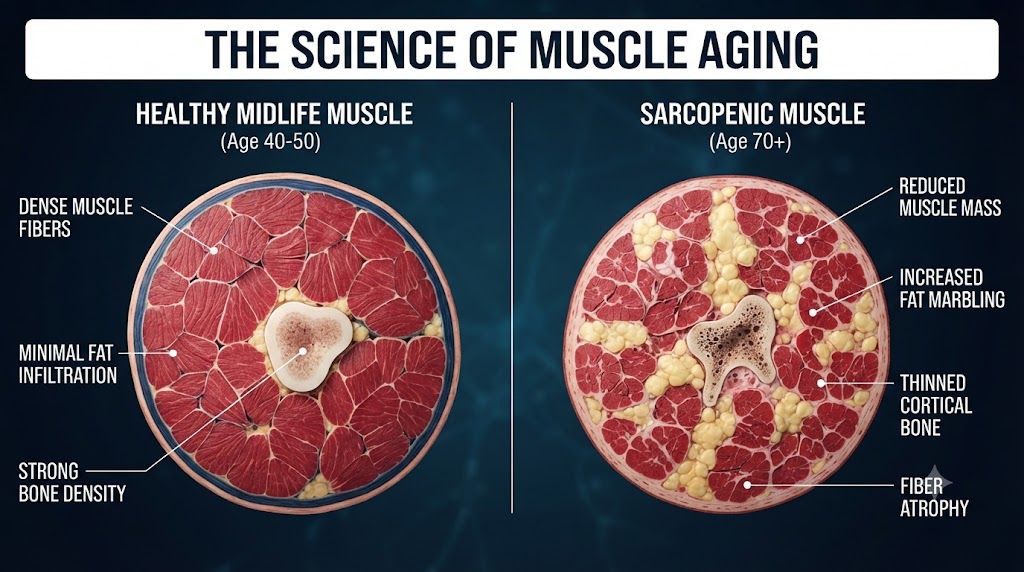
Aging naturally brings changes to the musculoskeletal system. Muscle mass and strength tend to decline, particularly when physical activity decreases.
This process can become clinically important when it progresses to sarcopenia, a condition characterized by declining skeletal muscle mass and strength and poorer physical performance.
The consequences can extend far beyond appearance.
Lower muscle strength can make everyday activities harder and increase vulnerability to falls, disability, loss of independence and other adverse health outcomes. The 2026 Scientific Reports review describes sarcopenia as being associated with falls, fractures, functional disability, hospitalization and mortality. (Nature)
This helps explain why researchers increasingly focus on muscle function, rather than simply muscle size.
A person does not need to look like a bodybuilder to benefit from stronger muscles.
Being able to rise from a chair easily, carry a suitcase, climb stairs or maintain balance may be much more meaningful for long-term independence.
Strength Is a Form of Physical Reserve
Think of muscle strength as a reserve.
When you are young and physically active, you generally have considerable reserve capacity. As you age, that reserve gradually decreases.
Building and maintaining strength may therefore give you a larger buffer against age-related decline.
For example, an older adult with good leg strength may find it easier to recover after illness, navigate stairs, avoid falls and continue living independently.
That is one reason strength training has increasingly become part of conversations about healthspan, not merely fitness.
🔬 What the Latest Research Says
One of the most interesting developments in 2026 is the growing amount of research examining resistance exercise over longer periods.
A 2026 study published in the British Journal of Sports Medicine investigated long-term resistance training and all-cause and cause-specific mortality using data from three large prospective cohorts. The researchers also examined how resistance exercise interacted with aerobic physical activity. (PubMed)
This is important because earlier research often relied on relatively simple questions such as whether someone exercised or did not exercise.
Long-term studies can provide a better picture of how exercise habits over many years relate to health outcomes.
Earlier Meta-Analysis Found Lower Mortality Risk
A systematic review and meta-analysis published in 2022 examined 10 studies involving resistance training and mortality.
Compared with no resistance training, any amount of resistance training was associated with:
- 15% lower risk of all-cause mortality
- 19% lower risk of cardiovascular mortality
- 14% lower risk of cancer mortality
The researchers also found evidence suggesting a nonlinear dose-response relationship, with the largest estimated reduction in all-cause mortality occurring around 60 minutes of resistance training per week in the available data. (ScienceDirect)
However, these findings should not be interpreted as meaning that exactly 60 minutes per week is a universal longevity prescription.
The studies were observational, and the researchers themselves emphasized the need for additional research.
The more useful takeaway is simpler:
You may not need enormous amounts of strength training to potentially gain meaningful health benefits.
👴 Strength Training Can Help Older Adults Too
One of the biggest misconceptions about resistance exercise is that it is mainly for younger adults.
The latest evidence challenges that idea.
The 2026 Scientific Reports systematic review included 72 studies and 6,204 older adults with sarcopenia. Participants ranged in average age across studies from approximately 61 to nearly 90 years. (Nature)
Researchers found that physical exercise improved:
- Skeletal muscle mass
- Muscle strength
- Physical performance
Importantly, resistance exercise was more effective than aerobic exercise for increasing skeletal muscle mass in the analyzed studies. (Nature)
That does not mean aerobic exercise is unimportant.
Rather, the evidence suggests that different forms of exercise have different strengths.
Aerobic Exercise and Strength Training Are Different Tools
Walking, cycling, swimming and other aerobic activities are excellent for cardiovascular fitness and endurance.
Resistance training provides a different stimulus.
It challenges muscles to produce force against resistance. That resistance can come from:
- Free weights
- Resistance machines
- Resistance bands
- Cable systems
- Body weight
- Household objects
- Other forms of external resistance
For healthy aging, combining both types of exercise may therefore make more sense than choosing one over the other.
❤️ The Connection Between Strength and Cardiovascular Health
Strength training is not traditionally thought of as a cardiovascular workout, but its potential health effects extend beyond muscles.
Muscle tissue is metabolically active and plays an important role in glucose regulation and energy metabolism.
Regular resistance exercise can help improve muscular fitness while supporting broader metabolic health.
The mortality evidence is particularly interesting because previous research has found associations between resistance training and lower cardiovascular mortality. The 2022 meta-analysis estimated a 19% lower risk of cardiovascular mortality among people undertaking resistance training compared with those doing none. (ScienceDirect)
However, resistance training should complement rather than replace aerobic activity.
A well-rounded fitness routine can include both:
🏋️ Resistance exercise: muscle strength and functional capacity
🚶 Aerobic exercise: cardiovascular endurance
🧘 Mobility and balance work: movement quality and stability
🚶♂️ Daily physical activity: maintaining an active lifestyle outside formal workouts
The combination may be particularly valuable for long-term health.
🦴 Stronger Muscles, Stronger Independence
Longevity is sometimes measured simply as the number of years a person remains alive.
But another concept is arguably more important: healthspan.
Healthspan refers broadly to the years spent in good health and functional independence.
Imagine two people who both live to age 85.
One remains mobile, can travel, cook, shop, climb stairs and participate in hobbies.
The other spends the final decade with severe mobility limitations and requires substantial assistance with daily activities.
Both have similar lifespans, but their healthspans are very different.
Strength training may help shift this equation by preserving physical capacity.
Strong legs, hips and core muscles can be particularly valuable because lower-body strength contributes directly to everyday movement.
Squatting down, getting out of a chair, climbing stairs and recovering from a stumble all require muscular force.
This is why exercises such as squats, step-ups, lunges and controlled resistance movements can become increasingly important as people age.
🧠 Could Strength Training Support Brain Health?
The relationship between exercise and brain health is another rapidly developing research area.
Physical activity affects multiple systems involved in healthy aging, including cardiovascular function, metabolism, inflammation and vascular health.
Although research specifically proving that resistance training extends cognitive health is not yet as definitive as the evidence for improvements in strength and physical function, maintaining physical fitness may contribute to a broader healthy-aging strategy.
This is another reason not to think of strength training as merely a way to build muscle.
The body operates as an interconnected system.
Improving physical function can help people remain active, socially engaged and independent—all factors that may contribute to quality of life as people age.
⚙️ How Strength Training Works Against Age-Related Decline
Resistance training creates a stimulus that tells the body it needs to maintain or increase muscular capacity.
With consistent training, the nervous system becomes better at recruiting muscles, while the muscles themselves adapt to repeated resistance.
Over time, this can improve:
1. Muscular Strength 💪
You become better at producing force.
2. Muscle Mass 🏋️
Regular resistance exercise can help preserve or increase lean muscle tissue.
3. Physical Performance 🚶
Improved strength can translate into better performance during everyday activities.
4. Balance and Stability ⚖️
Strengthening the lower body and trunk can support functional stability.
5. Physical Independence 🏠
Greater functional capacity may make everyday tasks easier.
The 2026 systematic review found moderate-certainty evidence supporting exercise for improvements in muscle strength and physical performance among older adults with sarcopenia. (Nature)
🥗 Exercise and Nutrition: A Powerful Combination
Exercise does not operate in isolation.
The 2026 systematic review found that combining physical exercise with nutritional supplementation produced greater improvements in muscle mass and strength than either intervention alone in the analyzed studies. However, the researchers also noted that the certainty of evidence for some of these combined interventions was low to very low. (Nature)
This highlights an important principle:
Healthy aging is a lifestyle system rather than a single intervention.
Strength training works best when combined with adequate nutrition, recovery and regular physical activity.
Protein is particularly important because muscles require amino acids to repair and remodel tissue.
Good dietary sources can include:
- Eggs
- Milk and yogurt
- Fish
- Chicken
- Soy foods
- Beans and lentils
- Paneer
- Nuts and seeds
People with specific medical conditions or dietary restrictions should discuss their nutritional needs with a qualified healthcare professional or dietitian.
⏱️ How Much Strength Training Do You Need?
The answer depends on age, experience, goals, health status and current fitness.
You do not need to spend hours in a gym every day.
For many healthy adults, a practical approach is to perform resistance exercises regularly throughout the week while allowing adequate recovery.
A beginner might start with:
2 sessions per week
Each session could include movements targeting:
- Legs
- Hips
- Back
- Chest
- Shoulders
- Arms
- Core
Bodyweight exercises can be enough for beginners.
Examples include:
Chair squats
Sit toward a chair and stand back up under control.
Wall push-ups
A beginner-friendly way to practice pushing strength.
Step-ups
Use a stable step or platform to train the legs.
Resistance-band rows
Useful for strengthening pulling muscles.
Calf raises
A simple exercise for the lower legs.
The goal should not be to exhaust yourself.
The goal is progressive adaptation.
As exercises become easier, resistance or repetitions can gradually increase.
📈 Consistency Matters More Than Showing Off
One of the biggest mistakes people make is confusing difficult workouts with effective workouts.
You do not need to lift extremely heavy weights to pursue healthy aging.
A sustainable program is often more useful than an aggressive program that causes injuries or burnout.
Think long term.
If you can comfortably perform two or three appropriate sessions every week for years, that consistency may be more valuable than completing an intense six-week program and then stopping.
Longevity training is not about winning a single workout.
It is about maintaining physical capacity over decades.
🧓 Is It Ever Too Late to Start?
No age completely eliminates the possibility of improving strength.
The 2026 evidence involving older adults with sarcopenia provides an important reminder: even people already experiencing age-related muscle loss can improve strength and physical performance through exercise. (Nature)
That does not mean every person will respond identically.
Older adults with significant frailty, osteoporosis, cardiovascular disease, joint problems or other medical concerns may need individualized guidance.
But age alone should not automatically be considered a reason to avoid resistance training.
In fact, the older you become, the more important maintaining functional strength may become.
⚠️ What the Research Does NOT Prove
It is easy to see headlines claiming that lifting weights will make you live longer.
The science is more nuanced.
Most long-term mortality studies are observational. Researchers observe people’s exercise habits and compare health outcomes.
That can reveal powerful associations, but it cannot establish with certainty that resistance training itself caused the difference.
People who strength train may also:
- Eat healthier diets
- Avoid smoking
- Have higher incomes
- Sleep differently
- Perform more aerobic activity
- Have better access to healthcare
- Have fewer underlying health problems
Researchers attempt to adjust for many of these factors, but statistical adjustment cannot eliminate every possible source of confounding.
The 2026 sarcopenia review provides another important example of scientific caution: while exercise improved muscle mass, strength and physical performance, only one randomized trial reported mortality, so the authors did not perform a mortality meta-analysis and stated that the evidence was insufficient for definitive conclusions about mortality. (Nature)
So the scientifically responsible statement is:
Strength training is strongly associated with healthier aging and better physical function, while evidence that it directly extends lifespan remains less definitive.
🔥 The Biggest Longevity Lesson
Perhaps the most important message from the latest research is not that everyone needs to become a serious weightlifter.
It is that muscle strength is a health asset worth protecting.
Think about the things you want to continue doing at age 70, 80 or 90.
Travel.
Walk outdoors.
Play with grandchildren.
Carry your luggage.
Climb stairs.
Get up from the floor.
Garden.
Dance.
Shop independently.
All of these activities require physical capacity.
Strength training can help build the physical foundation that makes them possible.
🏋️ A Simple Longevity-Focused Weekly Plan
For a generally healthy beginner, a simple structure could look like this:
Monday — Strength 💪
Squats
Wall or incline push-ups
Resistance-band rows
Glute bridges
Calf raises
Core exercise
Tuesday — Walking 🚶
A comfortable brisk walk.
Wednesday — Recovery 🧘
Gentle mobility or normal daily activity.
Thursday — Strength 💪
Step-ups
Hip-hinge movement
Band rows
Shoulder press
Supported lunges
Core exercise
Friday — Walking 🚶♀️
Moderate aerobic activity.
Saturday — Optional Activity 🌳
Cycling, swimming, hiking, sports or another enjoyable activity.
Sunday — Recovery 😴
Rest and recovery.
The exact exercises and intensity should be adjusted to the person’s fitness level and health status.
🌟 The Future of Longevity Research
The science of healthy aging is moving beyond the simplistic question of “How long can humans live?”
Researchers are increasingly interested in another question:
How long can we remain strong, mobile and independent?
That shift could make resistance training increasingly important.
Future studies may help clarify exactly how much resistance exercise is optimal, how training interacts with aerobic exercise, whether different training intensities produce different longevity outcomes, and which strategies work best for older adults.
The 2026 research already suggests that exercise should be considered a first-line strategy for improving muscle health in older adults with sarcopenia, while also emphasizing that some questions—including the effect on mortality—remain unresolved. (Nature)
That combination of encouraging evidence and scientific caution is important.
🏁 Conclusion: Build Strength for the Years Ahead
Strength training is no longer simply about aesthetics or athletic performance.
The latest research increasingly connects resistance exercise with the things that matter most as we age: muscle strength, physical performance, independence and potentially lower mortality risk.
Large observational studies and meta-analyses have found associations between resistance training and reduced mortality, while randomized research in older adults shows meaningful improvements in strength, muscle mass and physical performance. (ScienceDirect)
But longevity is not about finding one magical exercise.
The best strategy is likely a combination of regular resistance training, aerobic activity, nutritious food, sufficient recovery, sleep and other healthy lifestyle habits.
You do not have to become a bodybuilder.
You simply need to keep your muscles useful.
Train for strength today so your future self can keep moving tomorrow. 💪❤️
SEO Tags
strength training and longevity, strength training benefits, resistance training longevity, muscle strength and aging, healthy aging, exercise and longevity, strength training for seniors, sarcopenia, muscle loss with age, resistance exercise, longevity research 2026, healthy lifespan, healthspan, aging and fitness, exercise for older adults, muscle health, strength training benefits for older adults